

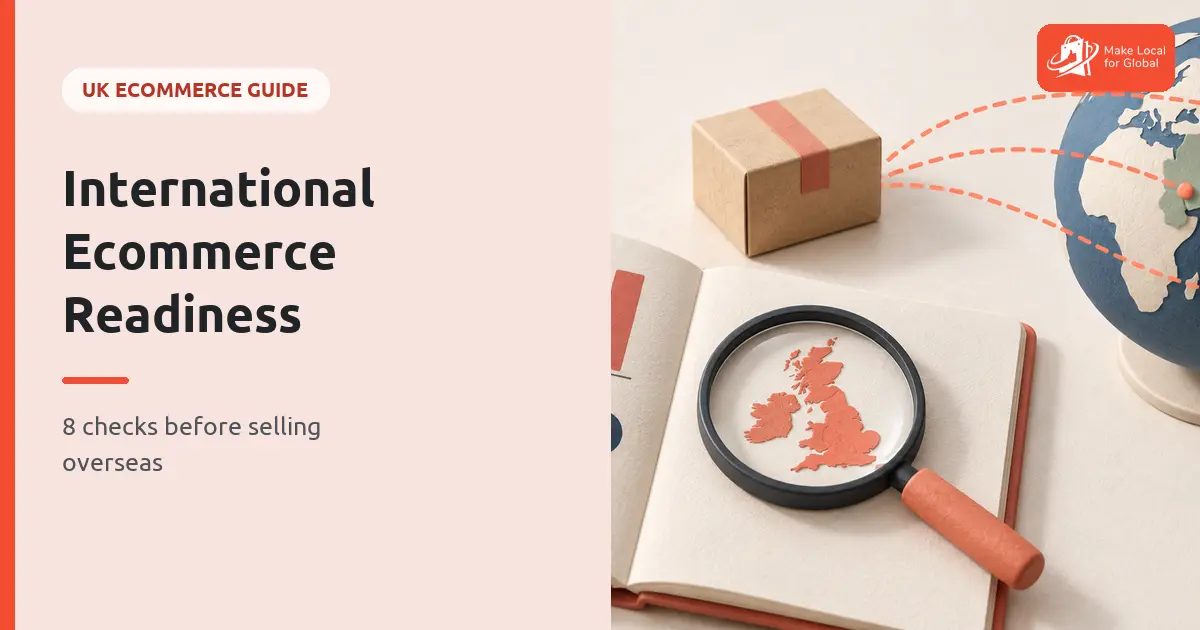
A practical guide to testing overseas demand, mapping landed cost and checking the route before a UK business commits to international selling.

Selling internationally from the UK can open a useful new route for a small business, but a larger audience does not automatically mean a better market. Delivery, border charges, customer expectations, product rules and the work of supporting an overseas order all affect whether a sale makes sense.
A measured first step is to choose one destination, verify a buyer signal, map the costs and requirements, then test a route you can support. This guide explains that process for early-stage ecommerce businesses. It is practical planning information, not legal, customs, tax or financial advice. Requirements depend on your goods, route and circumstances, so confirm them with current official guidance or a qualified adviser.
Work through six short lessons on demand, landed cost, customs, delivery, local fit and a limited pilot. Your answers become a personalised three-page market-entry plan.
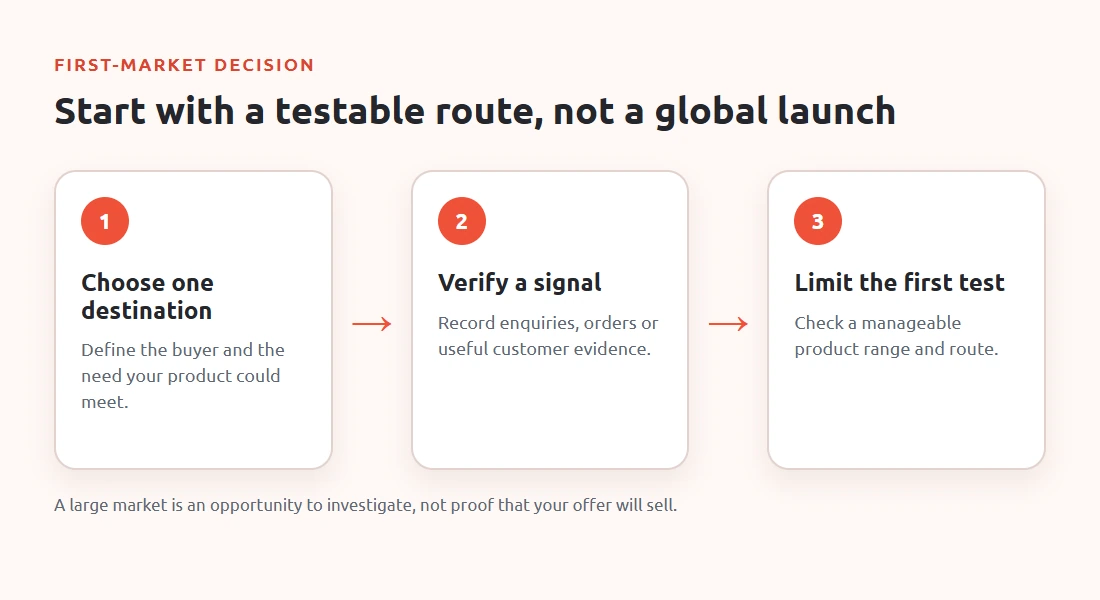
Start with a specific country or market rather than planning to sell everywhere. Look for a signal close to your business: repeated enquiries from that destination, orders you already receive, useful conversations with potential buyers, or a clear gap in the local offer. Competitor research and market reports can help you ask better questions, but broad market size alone does not prove that people want your product at a price that can cover the route.
Write down the buyer group, the need your product addresses and where the signal came from. Check whether the product can be shipped, serviced and supported there. Note what you do not know yet, such as preferred sizes, local alternatives, common payment methods or delivery expectations. The UK Government’s export preparation guidance can help you structure early readiness questions and find relevant support.
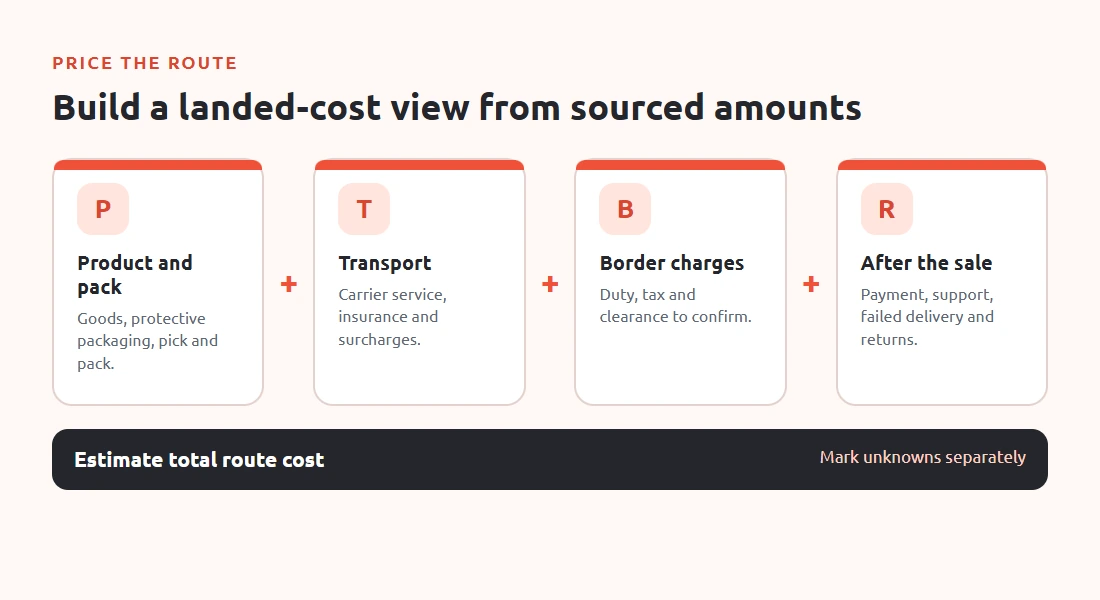
International pricing should account for more than the product and the headline postage rate. Build a route-specific checklist of product cost, packaging, pick and pack, transport, insurance if used, payment fees, currency conversion, duties, taxes, customs clearance, returns and the time needed for support. Some charges may be paid by the buyer on arrival; others may be collected earlier or included in a delivered-duty-paid service. Confirm what your carrier quote actually includes.
Keep sourced figures separate from estimates. Ask carriers or fulfilment partners to quote the same parcel, destination and service level so that you are comparing like with like. Check for fuel, remote-area, handling or address-correction surcharges. Include the cost of a failed delivery or a return where it could materially change the economics. A route that looks attractive before these costs may not leave enough contribution to support the order.
Before sending goods, check which customs steps apply to the product and route. Depending on the circumstances, a UK business may need an Economic Operators Registration and Identification number, a commodity code, origin and customs-value information, supporting documents, licences or an export declaration. The Government’s guidance on getting a UK EORI number, classifying goods for the UK Trade Tariff and making an export customs declaration explains important starting points.
Do not choose a code because another seller used it for a similar-looking product. Classification can affect duties, controls and documentation. Check whether the goods need a certificate or licence, whether restrictions apply, and what the destination country’s customs authority requires. Northern Ireland routes can follow different processes from Great Britain, and rules can change. Record the source and date for each decision and ask for specialist help if classification or responsibility is unclear.
VAT treatment also depends on where the goods are sent from, the destination and the transaction. HMRC’s guidance on exports and VAT explains conditions and evidence for different export situations. Do not assume that every overseas order can be treated the same way. Keep the invoice, proof of dispatch and records required for your own circumstances, and confirm the correct treatment with HMRC guidance or an accountant.
Choose a carrier service that fits the product and the promise you want to make. Compare tracking, likely transit time, delivery attempts, customs handling, proof of delivery, compensation limits and the process for exceptions. A displayed estimate should reflect the service and route you have checked, with a clear explanation that customs processing can affect timing.
Tell buyers what they can expect to pay and when. If import charges may be due on delivery, explain that before checkout and confirm which party handles them. If charges are collected upfront, make sure the carrier or fulfilment arrangement supports that. Set out how a customer can ask about a delay, refuse a parcel or return an item. Check the applicable consumer rules for the destination rather than copying a domestic policy without review.
Localisation is more than translating a product page. Check product safety, labelling, ingredients or materials, packaging, instructions, measurement units, electrical requirements and any product-specific restrictions that apply. Review the complete buying journey: currency display, payment options, delivery information, customer service availability and how people can contact you if something goes wrong.
Use a competent reviewer for language that affects product use, safety or contractual terms. Confirm which standards or registrations apply with the relevant official source. Make only claims you can support, and be clear about what is included in the package and which charges are not. A polished translation cannot compensate for an unclear offer or a product that does not meet a destination requirement.
Use six focused lessons to connect market evidence, landed cost, customs and delivery before planning a limited overseas pilot.
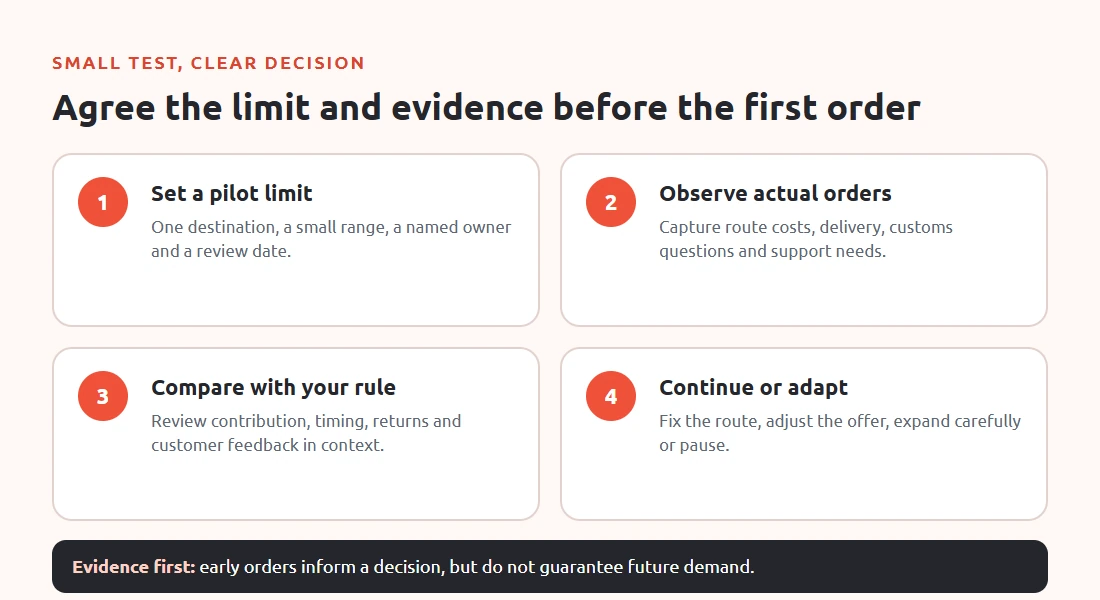
Choose a test that matches your capacity: one market, a small product range and a service you can monitor. Set a quantity or budget limit, name the person responsible and choose a review date before the first promotion. Decide what evidence would support continuing, changing the offer or pausing. Avoid committing to a large stock purchase or permanent delivery promise before you understand how the route works in practice.
For each order, record the destination, actual shipping and border charges, delivery time, customer questions, failed deliveries, returns and contribution after costs. Note the exchange rate and when it was applied. Separate a confirmed cost from an estimate, and keep personal data out of general planning notes. A few early orders are useful learning, not a forecast of future demand.
Selling internationally from the UK is a sequence of checks, not a single switch in an ecommerce dashboard. Choose one market, verify the route and keep assumptions visible. If the evidence supports it, expand in stages. If it does not, adapt the offer or pause before the cost of learning becomes too high.
Use the free course to check market fit, route costs and a manageable pilot. If you also need a store and support, compare the £99/year plan.
Want to discuss your setup? Talk it through with MLFG.
PREFERRED SOURCE
Like what you’re reading? Add Make Local for Global as a preferred source on Google to see more of our articles when you search.



















Build your online presence without having to figure out everything yourself.