

Use six practical checks to decide whether your hobby is ready for a small business test, without risking more time or money than you can afford.


A hobby can feel ready for business long before the evidence is ready. You may enjoy making the product, receive encouraging comments and even have people say they would buy it. Those are useful signals, but they do not yet show whether the price works, the product can be delivered reliably or customers will make a real commitment.
A safer question is not simply, “Can I make money from my hobby?” It is: “Is my hobby ready to become a business through one small, measured test?”
Our free Hobby to Business Assessment helps you answer that question. It checks buyer relevance, demand evidence, pricing, repeatable delivery, available capacity and your willingness to run a defined test. It then gives you a practical result and next steps.
Answer six practical questions about buyers, demand, pricing, delivery, time and test commitment. You will receive a readiness result and a focused next step.
Your hobby may be ready for a small business test when you can identify a specific buyer, show evidence beyond compliments, set a price that covers the whole order, deliver a consistent promise, protect enough weekly time and define a limited paid trial.
You do not need perfect branding, a large product range or hundreds of followers before you test. You do need a clear offer and boundaries. A sensible first test could be one product, one type of customer, a £100 budget cap, five available orders and a four-week review date.
If several of those foundations are missing, keeping the activity as a hobby for now is not a failure. It protects your enjoyment while you replace assumptions with useful evidence.
The assessment asks six questions. Each question has three evidence levels worth 0, 2 or 4 points. The questions are not designed to predict success. They help you see which part of the idea is ready and which assumption should be tested next.
Enjoying what you make gives you creative energy, but a business also needs an external reason to buy. Try to describe the first customer in one sentence:
“I make personalised ceramic pet bowls for dog owners who want a practical housewarming or adoption gift.”
That is easier to test than “I sell handmade pottery for everyone”. A specific buyer helps you choose the right product, message, images and sales channel.
Friends, family and social followers may praise your work because they want to support you. Their encouragement matters, but it is different from buying behaviour.
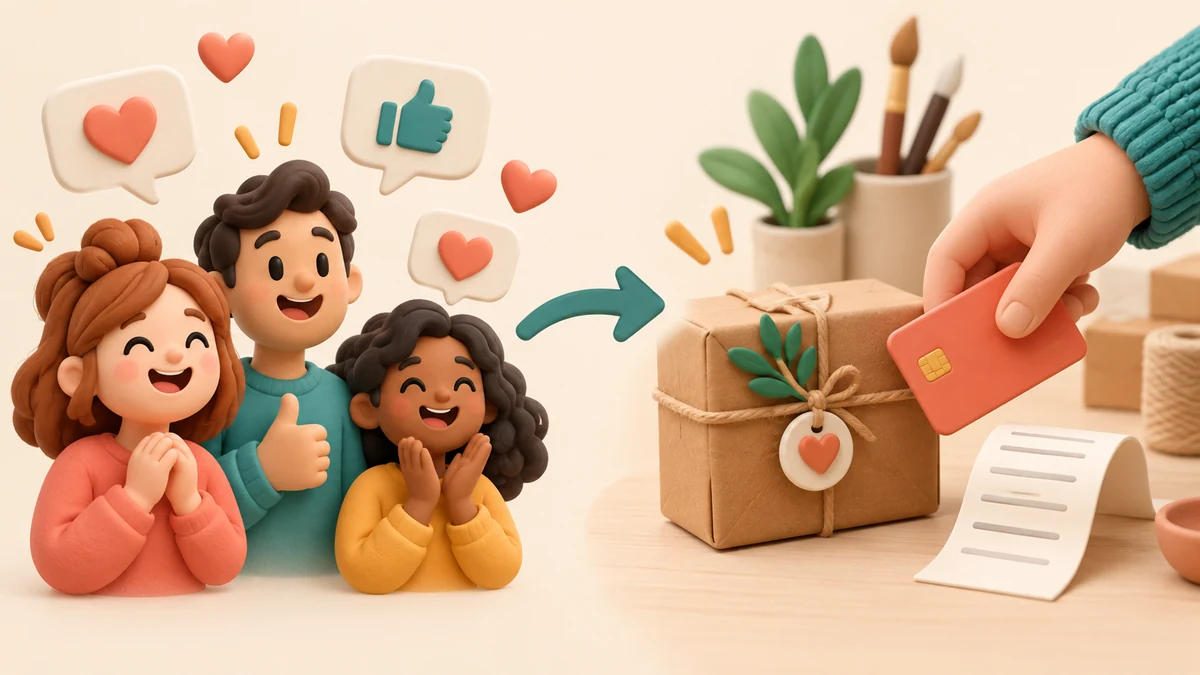
Evidence becomes stronger as the buyer accepts more commitment:
Evidence check: write down what each potential buyer actually did, what price they saw and whether they matched your intended audience. This is more useful than counting compliments alone.
The UK Government’s business guidance recommends going beyond friends and family and learning from people who represent your future customers. It also suggests checking what potential buyers think and what they would be willing to pay. Read the official guidance on testing and validating a business idea.
A common hobby-business mistake is pricing from materials alone. The customer is not only paying for wax, yarn, clay, ink or ingredients. The order may also use packaging, card fees, delivery, software, replacement stock, customer support and your working time.

Imagine you make a candle and plan to sell it for £18. A simple test calculation might look like this:
| Order cost | Example amount |
|---|---|
| Wax, fragrance, container and wick | £5.20 |
| Box, label and protective packaging | £1.30 |
| Payment and platform fees | £0.80 |
| Delivery paid by the seller | £3.50 |
| Problem and replacement allowance | £0.70 |
| Forty minutes of working time | £8.00 |
| Total planning cost | £19.50 |
In this example, an £18 price would not cover the planning cost. You could raise the price, reduce a cost, charge delivery separately, change the product or decide that this version should remain a personal hobby.
For a deeper pricing walkthrough, use our guide to pricing a product without guessing. HMRC also explains that business running costs can include stock or raw materials, financial costs, advertising and other qualifying expenses. Eligibility depends on your circumstances, so check the current self-employed expenses guidance.
Making one excellent item in ideal conditions is different from completing several customer orders to the same standard. A sellable offer needs a repeatable process for quality, lead time, packaging and communication.
Before accepting more orders, complete the entire journey yourself:
If each order must be reinvented from scratch, begin with a narrower offer. One size, one finish or three controlled options may be easier to price and deliver than unlimited custom work.
Selling adds work that may not feel like the hobby. You need time for enquiries, product pages, photographs, marketing, packaging, delivery problems, returns and bookkeeping as well as making.
Do not build your first offer around “whatever spare time is left”. Decide how many hours are genuinely available and turn that into an order cap. If you have two protected three-hour blocks each week and one order takes ninety minutes from start to finish, promising ten weekly orders will quickly create pressure.
A small cap such as two or three weekly orders can protect quality and enjoyment while you learn. You can raise it only when the process becomes quicker or more capacity becomes available.
Motivation is valuable, but an undefined launch can continue consuming money because there is no agreed point to review it. A useful test has one offer, one audience, a deadline, a budget limit and a decision rule.

For example:
This does not guarantee a future business. It gives you a controlled way to learn from behaviour instead of building a full shop around hope.
The app scores each of the six checks from 0 to 4, giving a maximum of 24 points. Your total places the idea in one of three result bands:
| Score | Result | What it means |
|---|---|---|
| 18 to 24 | Ready for a small business test | There is enough practical evidence for a limited, low-risk paid test. Keep the scope controlled and review real buyer behaviour. |
| 10 to 17 | Promising, with practical gaps | The idea has useful foundations, but one or two assumptions need stronger evidence before you commit substantial time, stock or money. |
| 0 to 9 | Keep it as a hobby for now | The business case is not yet strong enough for a larger commitment. Protect the hobby while testing the weakest assumption. |
The total is only part of the result. Look at the six individual dimensions. A strong total can still hide one serious weakness. For example, you may have buyers and a repeatable product but no price that pays for your time. That pricing gap should become the next test.
The assessment also provides a practical next action for every answer, three recommended next steps and an optional PDF copy after the email form is completed successfully.
Use the assessment to score all six readiness areas, find the strongest signal and turn the biggest gap into one practical next test.
Do not interpret a high score as permission to spend heavily. Write down the smallest version of the offer, the maximum number of orders, the budget and the review date. Test the real price with buyers who match the audience you selected.
Choose the lowest-scoring dimension and work on that first. Do not respond by creating a logo, ordering extra stock or adding more products unless the missing evidence genuinely requires it. Five customer conversations, one complete cost stack or three timed sample orders may teach you more.
Decide whether you actually want the responsibilities that come with selling. You might prefer occasional commissions, licensing your designs, teaching a workshop or simply keeping the activity personal. A hobby does not need to become a business to be valuable.
The assessment focuses on commercial readiness, not legal or tax advice. Once you begin accepting money, check the rules that apply to your product, sales channel and circumstances.
Before accepting orders: confirm the current rules for your exact product and circumstances. Food, cosmetics, toys and electrical items can require checks beyond general online-selling guidance.
Government guidance can change. Use the links above for the latest position and seek qualified advice where necessary.
Not always. You first need a clear offer, price and safe way to accept a limited order. A simple sales page, marketplace listing or direct paid trial may be enough for early evidence. A dedicated store becomes more useful when you are ready to present products consistently, accept payments and manage customer information professionally.
There is no universal number. Three full-price orders from matching buyers can be more informative than twenty discounted purchases from friends. Look at who bought, why they bought, whether the price worked, how delivery went and whether the process can be repeated.
No. The score is an educational readiness check for a small test, not financial advice or a forecast. Employment, savings, benefits, caring responsibilities, debt and personal risk all need separate consideration.
That is useful information. You could keep the activity as a hobby, accept only occasional commissions, simplify the offer, license designs or work with someone who enjoys the commercial tasks. Becoming a business owner is not the only valid outcome.
Start with the weakest important assumption. If the buyer is unclear, hold five conversations. If demand is unproven, offer a small paid trial. If pricing is weak, complete one full cost stack. If delivery is inconsistent, make and pack three sample orders while timing the process.
You do not need to choose between “just a hobby” and “full business” in one leap. Find the evidence you already have, identify the weakest assumption and choose one practical next step.
Prefer to talk through the result first? Contact Make Local for Global for a practical conversation about the next step.
If you want the broader journey after the readiness check, read Start with a Hobby and Turn It into a Business and Which Ecommerce Business Should I Start?.
The Hobby to Business Assessment is an educational planning tool. It does not predict sales, profit or business success and does not replace legal, tax or financial advice.
PREFERRED SOURCE
Like what you’re reading? Add Make Local for Global as a preferred source on Google to see more of our articles when you search.









Build your online presence without having to figure out everything yourself.