

Use this subscription launch checklist to test billing, onboarding, fulfilment, support and cancellation before inviting your first members.


A subscription launch checklist helps you find out whether the promise, billing journey and ongoing service are ready before customers commit. A product page can look complete while important parts of the member experience are still assumptions. Use this guide to rehearse one whole cycle, identify the largest gap and choose a manageable first test.
This is a practical readiness guide, not a forecast of sales or retention. It complements our broader six-step plan for starting a subscription service by focusing on what to test before opening enrolment.
Review your offer, price, billing, onboarding, service and member controls. The free assessment turns your answers into evidence gaps and a practical next step.
Readiness does not mean every process is perfect. It means you can explain what the customer receives, when they are charged, how they get the first value, what happens when something goes wrong and how they manage the plan. You should also know which parts are tested, which are estimated and which remain unknown.

Write one plain sentence describing who the plan is for, what happens in each billing period and why that repeat value could matter to the customer. A box might contain a refill or a rotating selection. A digital membership might add resources or access. A service plan might include a scheduled review or maintenance visit.
Then ask someone unfamiliar with the idea to explain it back. Can they tell you what is included, how often it arrives or becomes available, what costs extra and how to ask for help? If they cannot, improve the offer before you spend heavily on promotion.
A recurring price should be compared with the work and costs of serving each billing period. For a physical subscription, list product, packaging, pick and pack, delivery, payment charges, replacements and support. For digital access, include content production, platform costs, updates and the time needed to answer members. Refunds, discounts and tax treatment may also affect the picture.
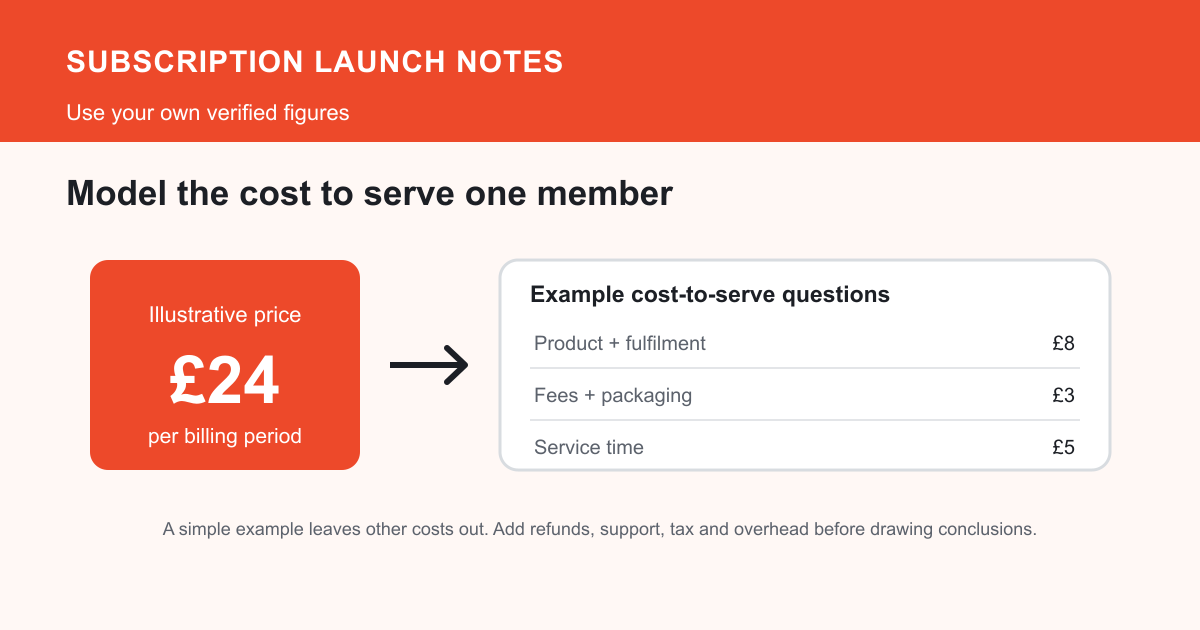
For illustration, a £24 monthly plan with £8 of product and fulfilment, £3 of fees and packaging, and £5 of service time would leave £8 before other costs, tax and overhead. This is arithmetic for showing the questions to ask, not a margin estimate for your business. Use supplier quotes, payment-provider information and your own time records wherever possible. Mark estimates as estimates.
Try a cautious scenario as well as your expected one. What if delivery costs rise, a customer requests a replacement or a discount applies? The Subscription Pricing Lab can help you examine price and cost assumptions, but its outputs do not establish that a business will be profitable.
Use the payment provider’s test environment to walk through the customer journey from the plan page to the first successful payment. Check the confirmation, receipt, account access and the date and amount of the next charge. Then test a failed payment and confirm what the customer sees, what the business does next and whether access or delivery changes.

Map the first day after payment. What should the subscriber do, where do they find access or delivery information and when should the first useful outcome arrive? Ask a tester to follow the welcome message without coaching. Broken links, unclear dates and missing instructions are easier to fix before launch.
Next, map one complete service cycle. Confirm supplier handovers, stock or staff capacity, delivery dates, support ownership and the process for late, damaged or unavailable items. Digital products also need a route for login problems, missing files and access changes. A normal order is only part of the test; include at least one realistic exception.
Use the assessment to mark what is proven, what is still an estimate and which issue deserves your next test. It is designed to guide a decision, not predict growth.
Before opening enrolment, test where someone can manage their plan, update details, pause if offered, and cancel. Explain when each change takes effect, what happens to the next payment or delivery and how confirmation is provided. Do not make cancellation depend on a hidden route or an unclear support process.
Consumer rules depend on the customer, product, contract and jurisdiction, and can change. Review current official guidance for your specific offer. UK sellers can start with GOV.UK guidance on online and distance selling and check the current status and scope of the Digital Markets, Competition and Consumers Act subscription provisions. This article is operational guidance, not legal advice.
A pilot limits the operational commitment while you learn. Choose a manageable number of members or a short, clearly explained test. Decide what evidence you will review and when. For example: did members understand the offer, receive what was promised, reach the first value, need help or choose to renew after experiencing a full cycle?
Keep a simple launch log. Record the assumption, the test, what happened and the next decision. Separate observations from interpretations: a cancellation is a recorded event; the reason needs evidence. Early interest or a few successful payments is not proof of stable retention or profit.
| Launch area | Evidence to record | Next practical check |
|---|---|---|
| Recurring value | Buyer feedback, repeat need and promised cadence | Ask a new tester to explain the next cycle |
| Cost to serve | Current quotes, fees, time and replacement assumptions | Recalculate one cautious billing period in £ |
| Billing journey | Test sign-up, confirmation, renewal and failed payment | Repeat on a phone and with a first-time user |
| Service and support | Capacity, delivery schedule, owner and exception route | Rehearse one normal cycle and one problem |
| Member controls | Plan changes, cancellation steps and confirmation | Ask someone to find and describe each control |
Test the promise, full cost to serve, sign-up and billing journey, first-use instructions, service capacity, support route and member controls. Use a test environment and a first-time reviewer wherever possible.
There is no universal number. Choose a group small enough to serve carefully and large enough to answer a specific operational question. Decide the limit, measures and review date before inviting people.
No. A checklist can help reveal evidence gaps and operational risks, but it cannot predict demand, retention, profit or success. Use customer behaviour and verified costs to make decisions over time.
There is no one suitable price for every subscription. Start with the value customers understand and the complete cost to serve each period. Confirm fees and costs, then test assumptions without treating an example or simulator result as a recommendation.
Before you open enrolment, be able to explain what repeats, test what the customer experiences and show which numbers are confirmed. Choose the largest unresolved gap, gather evidence and review the complete cycle before expanding the offer.
Complete the free assessment for a focused evidence map and three practical validation actions. When you are ready to build, compare what is included in the MLFG plan.
For related planning, see the subscription service launch plan, explore the Subscription Pricing Lab or talk with MLFG about setting up your store.
PREFERRED SOURCE
Like what you’re reading? Add Make Local for Global as a preferred source on Google to see more of our articles when you search.


























Build your online presence without having to figure out everything yourself.