

Calculate a wholesale price from product, freight, packing and payment costs. Follow a worked example in £ and compare a quote with your target contribution margin.

A wholesale price has to cover more than the item leaving your workshop or warehouse. Freight, packing, order delivery and payment charges can all change what is left after a retailer places an order. A clear wholesale pricing formula helps you see those costs before you send a quote.
This guide explains how to calculate a supplier-side trade price from current costs, order quantity, payment fees and a contribution margin target. It uses a worked example in pounds sterling (£), then shows what to check before you share the price with a retailer. It does not choose a price for your business or predict demand.
If you want to run your own numbers, the free Wholesale Pricing Lab works out a cost-covering floor and a trade price for the margin you select.
Enter product, freight, packing, order delivery and payment costs. Compare your current quote with a target contribution margin using your own order size.
A useful first model estimates what one supplied item costs you, including a fair share of order-level expenses. It then accounts for percentage payment fees and a contribution margin goal. The result is a planning figure for your trade price, not a guarantee that a retailer will accept it.
Keep the supplier calculation separate from the retailer’s resale calculation. Your trade price is the amount the retailer pays you under the agreed terms. The retailer then has its own costs, tax position, selling price and desired margin. A price that works for one side may not work for the other, so both sides of the offer need checking.
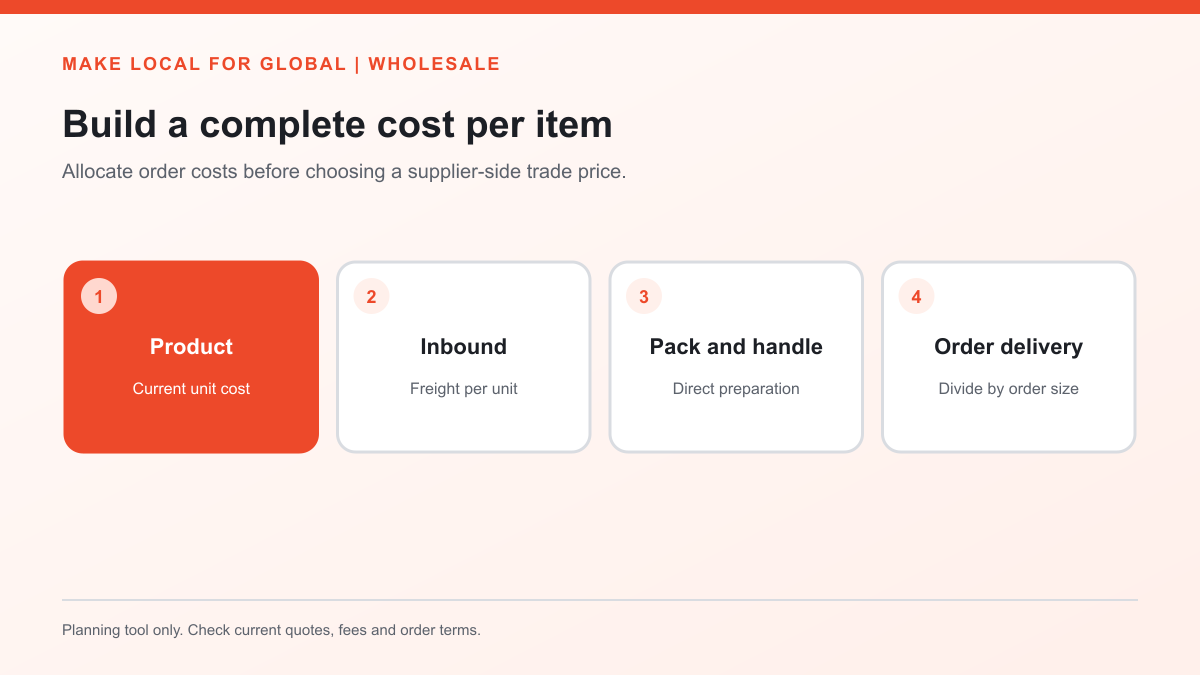
Start with a defined product and order size. Use a current supplier invoice or quote for the unit cost. Add inbound freight allocated to each item, and include packing or handling that is genuinely caused by fulfilling that item. If an expense applies once to an order, divide it across the number of items in that order.
For example, if delivery costs £9.60 for an order of 24 units, the simple allocation is £0.40 per unit. This assumes the cost is shared evenly. If the parcel size, weight or packaging changes with the quantity, use an allocation that reflects the actual way the cost is charged rather than dividing blindly.
Keep estimates visible. A supplier quote may exclude shipping, duties, breakage or a minimum order charge. A fulfilment provider may charge by parcel size rather than by item. Record the source and date for each number, then replace estimates when you have a current bill or written quote.
Payment providers may charge a percentage, a fixed amount per transaction, or both. If you use a card payment, apply the percentage to the price that the provider actually charges on. Allocate a fixed fee across the items in the order when you are estimating contribution per item. If the retailer pays by bank transfer and you have no transaction fee, enter zero rather than keeping a sample card rate.
Do not treat VAT as a simple fee percentage inside every wholesale model. Whether VAT is charged, reclaimed or included depends on your registration, product and transaction. Check current official guidance for your situation. A VAT-registered business generally charges VAT on taxable goods unless an exemption or special treatment applies, but this article and app do not calculate VAT. See the HMRC guidance on charging VAT and seek qualified advice if you are unsure.
Margin and mark-up are different. A £10 cost sold for £15 has a £5 difference. The mark-up is £5 divided by £10, or 50%. The gross margin is £5 divided by the £15 selling price, or 33.3%. Be explicit about the denominator so a percentage is not mistaken for another measure.
This guide uses contribution margin after the direct costs entered and the payment fee. It is calculated as the amount left after those costs divided by the trade price. That amount is not net profit: it still has to support fixed overheads, tax, unpaid time and any other costs not included in the model. Gross margin in the accompanying app is shown before payment fees so the two measures remain distinct.
Let the direct cost per item include product cost, inbound freight, packing and the allocated share of order delivery. Add the allocated fixed payment charge to get the cost base used in the contribution calculation. If the percentage payment fee is f and your target contribution margin is m, the model is:
Target trade price = (direct cost per item + fixed payment fee per item) ÷ (1 − payment fee rate − target contribution margin)
Use the rates as decimals in the formula. For a 1.5% fee, the fee rate is 0.015. For a 30% target contribution margin, the margin is 0.30. The part left in the denominator must be above zero. A very high fee or target can make the calculation impossible; if that happens, review the assumptions instead of forcing a result.

Suppose a product costs £8.00 per item. Inbound freight is £0.60 per item, packing and handling is £0.40 per item, and delivery costs £9.60 for an order of 24. A fixed payment charge of £0.20 is also spread across those 24 items. The payment percentage is 1.5%, and the supplier chooses a 30% contribution margin target for this example.
| Calculation | Working | Per item |
|---|---|---|
| Product cost | Supplier quote | £8.00 |
| Inbound freight | Allocated per item | £0.60 |
| Packing and handling | Direct item cost | £0.40 |
| Order delivery | £9.60 ÷ 24 items | £0.40 |
| Fixed payment fee | £0.20 ÷ 24 items | about £0.01 |
| Cost base for target formula | Direct cost plus fixed fee share | about £9.41 |
Using the unrounded cost base of about £9.4083, the target price is £9.4083 ÷ (1 − 0.015 − 0.30), which is about £13.7348. Rounding up to the next penny gives a target trade price of £13.74 per item. At that price, the payment percentage is about £0.21 per item and the contribution is about £4.13 per item, or just over 30% of the price. Across 24 items, the order value is £329.76 before any applicable VAT treatment.
The cost-covering floor for the same inputs is about £9.56 per item. That is not a recommended selling price: it leaves virtually nothing after the listed payment costs and direct expenses. The difference between a floor and a target price is useful because it shows whether the current quote leaves room for the contribution you want.
All figures are illustrative arithmetic. The £0.20 transaction charge, 1.5% payment rate and 30% margin are assumptions for this example, not typical rates or a recommendation. Replace them with current written terms, check how fees are applied, and recalculate for each relevant order size.
A supplier-side target does not show whether a retailer can sell at a suitable final price. Compare the trade terms, the retailer’s own costs and the total price their customer will see.
Before sending the quote, ask what the retailer needs to cover: incoming delivery, storage, packaging, payment charges, promotions, staff time, breakage or returns. Their required retail price may differ from your own direct-to-customer price. Confirm the intended pack size, minimum order, delivery terms and whether the quote is exclusive of VAT.
If the retailer plans to resell to consumers, make sure the price communication is clear and complete. The Competition and Markets Authority says consumer-facing total prices should include unavoidable mandatory charges where required. Read the CMA summary on clear and accurate prices and check the detailed current guidance for the type of offer you are making.

For more context on preparing a first wholesale conversation, see How to Sell Wholesale to Retailers: A First-Order Plan. If you also need to model cash, stock and payment timing, use the Wholesale Simulator. That is a separate check from this price calculation.
A simple target formula is: (direct cost per item plus fixed fee per item) divided by (1 minus the percentage payment fee minus the target contribution margin). It assumes the cost and fee inputs are accurate and that both percentages are less than 100% combined.
No. Wholesale is the trade price paid to the supplier under agreed terms. Retail is the amount the retailer charges its customer. The retailer needs to include its own costs and margin when deciding whether the trade offer is workable.
This calculator excludes VAT. Your obligations depend on registration status, the goods or services and the transaction. Check the current HMRC guidance or speak to a qualified adviser rather than treating VAT as a universal percentage added to this formula.
No. It shows the price that meets the selected arithmetic target using the costs entered. It does not measure buyer demand, retailer acceptance, competitor positioning or your full profit. Test whether the offer is understood and workable, and update the model when evidence changes.
Use one order size, current costs and a clearly named contribution target. Download a worksheet to keep the assumptions and next steps together.
PREFERRED SOURCE
Like what you’re reading? Add Make Local for Global as a preferred source on Google to see more of our articles when you search.

























Build your online presence without having to figure out everything yourself.