

Learn how to measure affiliate merchant dependency across commission, clicks and content, then plan useful alternatives and a manageable review routine.


An affiliate business can look diversified while depending on one merchant for most of its commissions, outgoing clicks or product coverage. A programme change, unavailable product or broken link may then affect several parts of the business at once. This guide explains how to measure that exposure, decide what deserves attention and build practical alternatives without treating diversification as a promise of stable income.
Review commission and click concentration, content reliance and your practical options in a short, free assessment.
Merchant dependency is the degree to which your publishing activity relies on one retailer, affiliate programme or commercial partner continuing to work as it does today. It is not limited to the share of commission credited to one account. A single partner may also account for most of your product links, comparison pages, buying guides or reader journeys.
That distinction matters because reported commission can lag changes in traffic and content. A merchant might represent a modest share of last month’s earnings but appear across most high-intent pages. Another site may have concentrated clicks yet earn relatively little from that partner. Both are signals to investigate, not enough on their own to predict what will happen next.

Start with a recent, consistent period such as the last 90 days. Record commission by merchant or programme, outgoing affiliate clicks by destination, and the proportion of useful content that depends on the largest partner. Use the same date range where possible, and note any missing reports or tracking changes. Do not fill gaps with guesses.
Divide commission attributed to the largest merchant by total commission for the period. For example, if a project records £240 of commission from one partner and £600 overall, that partner represents 40% of recorded commission for that period. The figure describes the supplied reports only. It does not account for reversals, attribution limits, future rates or other causes of change.
Compare outgoing clicks to the largest destination with all tracked affiliate clicks. This helps show where reader journeys currently lead. Before drawing conclusions, check whether your analytics labels destinations consistently and whether important links are missing tracking.
Estimate how much of your useful content would need updating if one partner or product range became unavailable. Count the pages that rely on that partner for recommendations, comparisons, specifications or links. A simple page count is only a starting point: a handful of highly visited guides may matter more than many low-use pages.
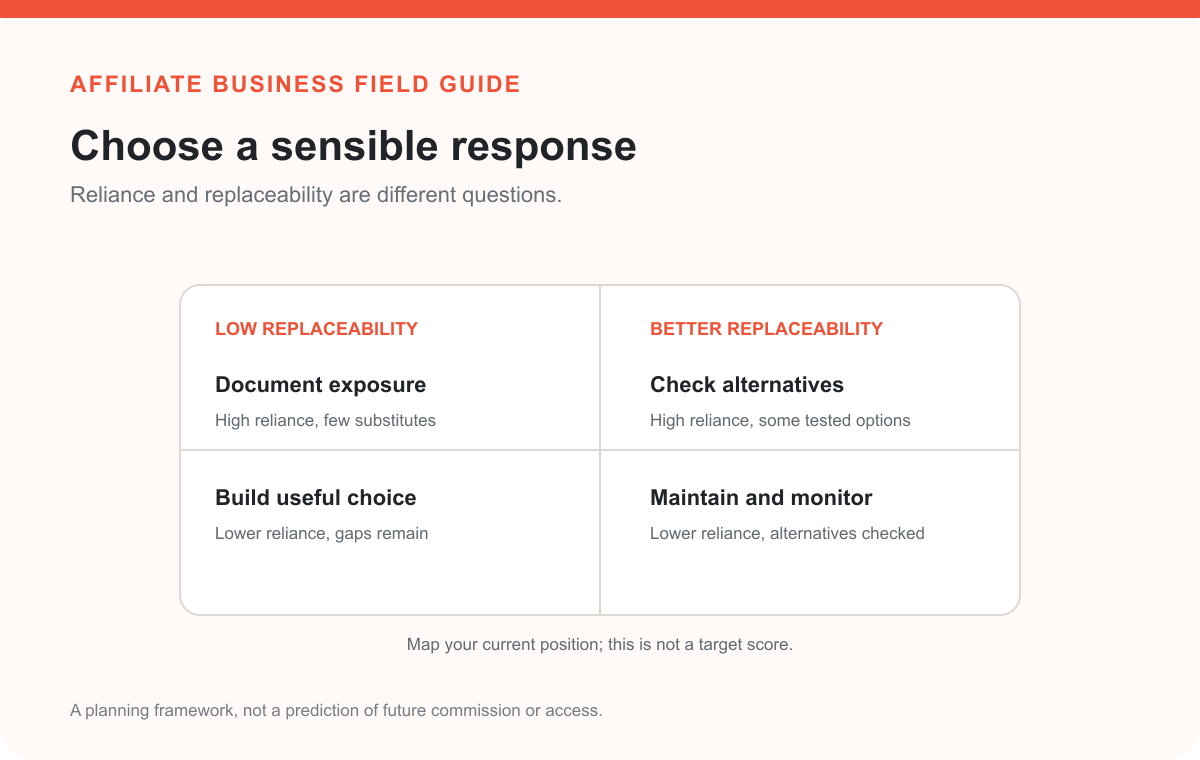
Keep these measures side by side rather than compressing them into a claim about business health. A high share is a prompt to understand the exposure and its replaceability. It is not proof that the arrangement is unsafe or that adding another programme will improve results.
The assessment helps organise recent reports and highlight information you still need to collect.
A second programme does not automatically reduce dependency. It may not cover the same products, offer a comparable reader experience or fit the editorial standards of your site. Check programme terms, link formats, tracking behaviour, payment rules and any restrictions directly with the programme before you make changes.
For important recommendations, ask whether a suitable substitute exists and whether you could update the page without rewriting its core advice. Keep product facts current, distinguish a genuine alternative from a poor substitute, and make clear when a recommendation is based on a particular partner’s availability. If no appropriate alternative exists, record that limitation rather than adding a weaker product to make a list look diversified.
Affiliate disclosures and programme rules remain important when you review or replace links. The UK Advertising Standards Authority explains that affiliate marketing should be clearly identifiable as advertising. Amazon’s own programme agreement and policies also set requirements for participants and can change, so consult the latest official text rather than relying on an old summary. These links are starting points for your own review, not legal advice.
For broader preparation, see our Amazon affiliate website checklist and guide to interpreting affiliate traffic and earnings inputs. Both address adjacent planning questions, while this article focuses on concentration and contingency.

Choose a cadence that fits your publishing volume. Once a month, save the reports you rely on, inspect links on your most important pages, confirm whether key products remain available, and record material programme changes. Compare like with like and annotate unusual events, such as a tracking outage or seasonal traffic spike.
Then choose one action: improve the quality of an important page, verify a missing data point, research a legitimate alternative or leave the current setup unchanged because there is no suitable substitute. Keeping a short decision log helps you distinguish a deliberate choice from an assumption.
A structured self-review can help you identify where the evidence is strong and where it is missing. Treat unknown commission or click shares as unknown. The next useful step may simply be to find the right report, improve link tracking or agree a review routine. A score should never replace your judgement about reader value, current programme terms or the actual suitability of alternatives.
Map your current concentration signals, note missing data and leave with a short list of practical checks to complete.
PREFERRED SOURCE
Like what you’re reading? Add Make Local for Global as a preferred source on Google to see more of our articles when you search.


























Build your online presence without having to figure out everything yourself.
