

Learn how to compare subscription prices in £, calculate contribution after fees, consider VAT and acquisition cost, and plan a clear buyer test.


Pricing a subscription is not simply a matter of copying a competitor or choosing a round number. You need a price that covers the service you provide, accounts for payment costs and gives you a clear hypothesis to test with customers. This guide shows how to compare monthly prices in £, work out the contribution left after listed costs and choose the next evidence to collect.
The free Subscription Pricing Lab puts three prices beside your service cost, payment fee, customer acquisition cost and expected paid months. Its lifetime figure is an assumption-led comparison, not a promise about retention or revenue.
Enter a lower, planned and higher price in £. See how payment costs, delivery and acquisition affect the amount left in each scenario.
Before deciding on a monthly fee, describe the offer in ordinary language. What does a subscriber receive, how often do they receive it, and what support or access is included? A monthly box, a software service, a membership and a replenishment plan have different delivery costs and customer expectations.
Write down what stays the same across your price options. If the higher price includes extra products, priority support or a longer commitment, you are comparing different offers as well as different prices. That may be a useful package test, but it answers a different question from “What happens when this same subscription costs more?”
A customer payment is not all available to spend. Start with the amount you charge, remove VAT from the revenue figure if the price includes VAT and you need to account for it, then subtract payment fees and the variable costs of serving that subscriber for the month. The remaining amount is a simple contribution estimate. It is not full profit: rent, staff, tax, your own time and other overheads may still be outside the calculation.

For example, suppose a VAT-exclusive subscription is £15 per month. You estimate a 2.9% payment fee plus a 30p fixed fee, and £4 of monthly service cost per subscriber. The modelled contribution is £15 minus about 44p in payment fees and £4 in service cost, or about £10.27 per subscriber per month. Check your actual provider terms because fees can depend on the payment method, country and plan.
| Monthly price | Payment fee assumption | Service cost | Contribution / month | Contribution margin |
|---|---|---|---|---|
| £12.00 | 2.9% + £0.30 | £4.00 | £7.35 | 61.3% |
| £15.00 | 2.9% + £0.30 | £4.00 | £10.27 | 68.4% |
| £18.00 | 2.9% + £0.30 | £4.00 | £13.18 | 73.2% |
These are worked examples, not recommended prices or typical results. They hold the fee and service cost constant to make the arithmetic easy to compare. In a real offer, fulfilment, support use, refunds and payment costs may change as the product or customer mix changes.
If the customer-facing price includes VAT, the full amount charged is not the same as the sales revenue retained by the business. The correct treatment depends on what you sell and your circumstances, so do not rely on a pricing calculator as tax advice. HMRC currently states that businesses generally need to register when taxable turnover goes over £90,000, or when they expect it to exceed that amount in the next 30 days, subject to the detailed rules. Read the current VAT registration thresholds and check which rate and place-of-supply rules apply to your offer.
The Pricing Lab lets you mark entered customer prices as VAT-inclusive and enter a VAT rate for modelling. That control only changes the arithmetic. It does not decide whether you must register, which VAT rate applies, or how to display your prices.
Customer acquisition cost, or CAC, is the amount you spend to gain a paying subscriber. Choose a consistent method for estimating it. You might include a campaign’s advertising spend, agency fee and relevant sales costs, then divide by the number of new paying customers attributed to that effort. A broad marketing budget divided by all historic customers can hide changes in channel performance.
Compare CAC with monthly contribution, not just the headline subscription price. If the £15 example leaves about £10.27 per month and CAC is £20, the simple model suggests roughly two paid months to recover CAC from contribution. That calculation assumes the subscriber stays, pays on time and has the same costs each month. It does not account for the time value of money, refunds, cancellations before the second payment or overheads.
Multiplying monthly contribution by expected paid months gives a rough lifetime contribution before acquisition cost. Using the unrounded monthly contribution, the £15 plan gives an estimated £82.12 across eight assumed paid months, before a £20 acquisition cost and broader overheads. That is a scenario, not a forecast of what future customers will do.
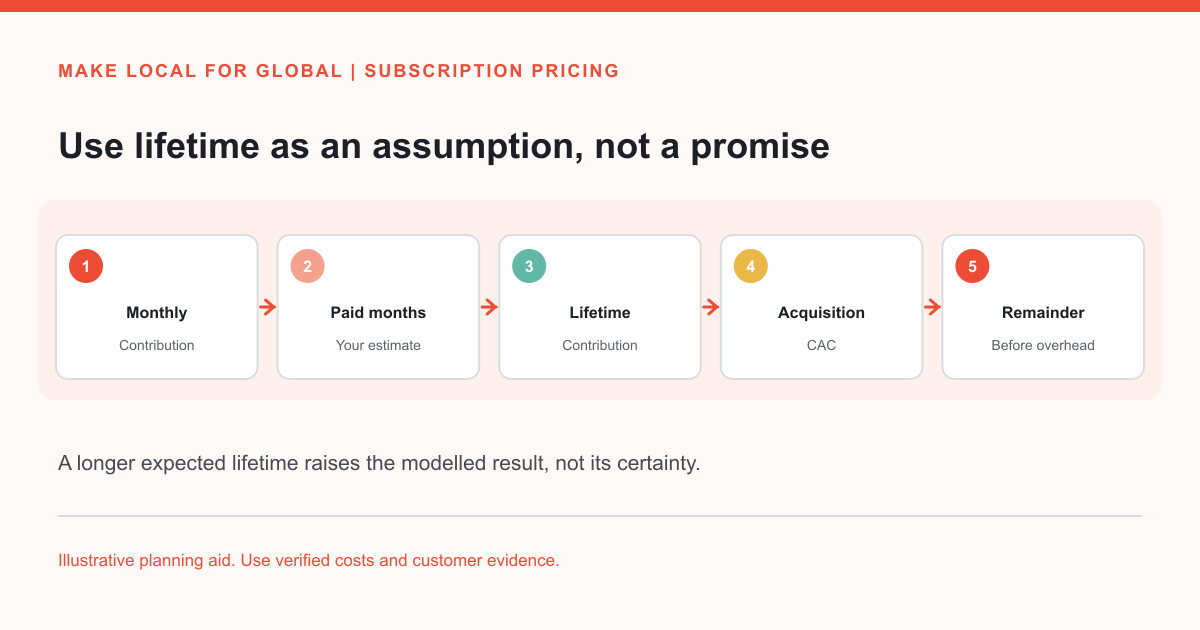
If you have subscribers already, use real renewal and cancellation records for cohorts that have had enough time to mature. Keep the period, plan and customer group consistent. If you are pre-launch, label the number as an assumption and update it when you have evidence. A separate Subscription Simulator can help you explore how acquisition and cancellations affect subscriber totals over time; the Pricing Lab is narrower and focuses on unit contribution across prices.
Pick a lower, planned and higher price in £ that each have a reason behind them. Your planned price might reflect the cost of delivering the offer and its scope. A lower option could test whether a more accessible entry point changes the number of suitable buyers. A higher option might test whether stronger positioning or a more complete offer is understood and valued. Do not assume the highest modeled contribution will produce the highest overall result: the tool does not estimate conversion or cancellation behaviour.

Keep the offer, audience, billing interval and sales route as comparable as practical. Set a small experiment before launching: which price is shown to whom, for how long, and what evidence will make you keep, change or investigate it? Record visits, checkout starts, completed payments, cancellations, refund requests and the questions buyers ask. Be clear about the full customer price and renewal terms.
Check the contribution at three £ prices, compare it with your acquisition cost and see where the result depends on an estimated customer lifetime.
For a consumer subscription, customers should be able to understand the amount and frequency of payment, what is included, when renewal happens and how to cancel. GOV.UK guidance on writing a fair contract for customers notes that some subscription contracts must also comply with rules under the Digital Markets, Competition and Consumers Act 2024. Requirements can change, so check current official guidance before you publish terms or a checkout flow.
Price transparency is part of the test too. Avoid presenting a partial amount if unavoidable charges apply. Make the recurring nature of the payment clear before purchase and ensure the cancellation route is easy to find. A price that looks attractive but leaves customers confused can undermine trust and produce poor evidence about the value of the actual offer.
For a broader overview of recurring revenue, costs and cancellations, read our subscription business guide to MRR, churn and costs. For a step-by-step introduction to offer setup and subscriber economics, use the subscription service launch plan. Each resource covers a different part of the decision.
Start with the cost of serving one subscriber for a month, payment fees and any required VAT treatment. Choose a contribution margin threshold that makes sense for your own operating plan, then calculate a price hypothesis and compare it with buyer evidence. The cost formula helps you understand a floor, but customers still need to value the offer at that amount.
There is no single margin that is right for every subscription. Delivery model, support needs, acquisition route, VAT treatment and fixed overheads all vary. The Pricing Lab asks you to set your own contribution margin threshold; that is a planning preference, not an industry benchmark or profit target.
No. A higher price can increase contribution per subscriber but may also affect whether people start, renew or recommend the service. The app compares contribution at the prices you enter. It does not estimate demand, conversion, churn or total profit. Use a controlled experiment and observed behaviour to learn more.
If you have mature subscription cohorts, calculate paid months from actual renewal and cancellation records and keep plan and cohort definitions consistent. If you do not yet have customer history, choose a cautious planning assumption, label it clearly and revisit it as evidence arrives. Do not treat an assumed lifetime as a guarantee.
Use the amount customers will actually see, but model the revenue and tax treatment accurately for your circumstances. VAT registration, rates and place-of-supply rules depend on the business and offer. Check current HMRC guidance or ask a qualified adviser rather than treating this calculator as tax advice.
Run the three-price comparison, note which assumptions matter most and choose one small buyer test. If you need help setting up your ecommerce offer, see the MLFG plan or talk through your next step.
This article is educational information, not financial, legal or tax advice. Check official guidance and get advice suited to your business before setting customer terms or relying on a pricing model.
PREFERRED SOURCE
Like what you’re reading? Add Make Local for Global as a preferred source on Google to see more of our articles when you search.

























Build your online presence without having to figure out everything yourself.